Depth-First Search (DFS) Algorithm
DFS goes deep before going wide. It picks a direction and follows it as far as possible. When it hits a dead end, it backtracks and tries the next path.
19 Mar 2024
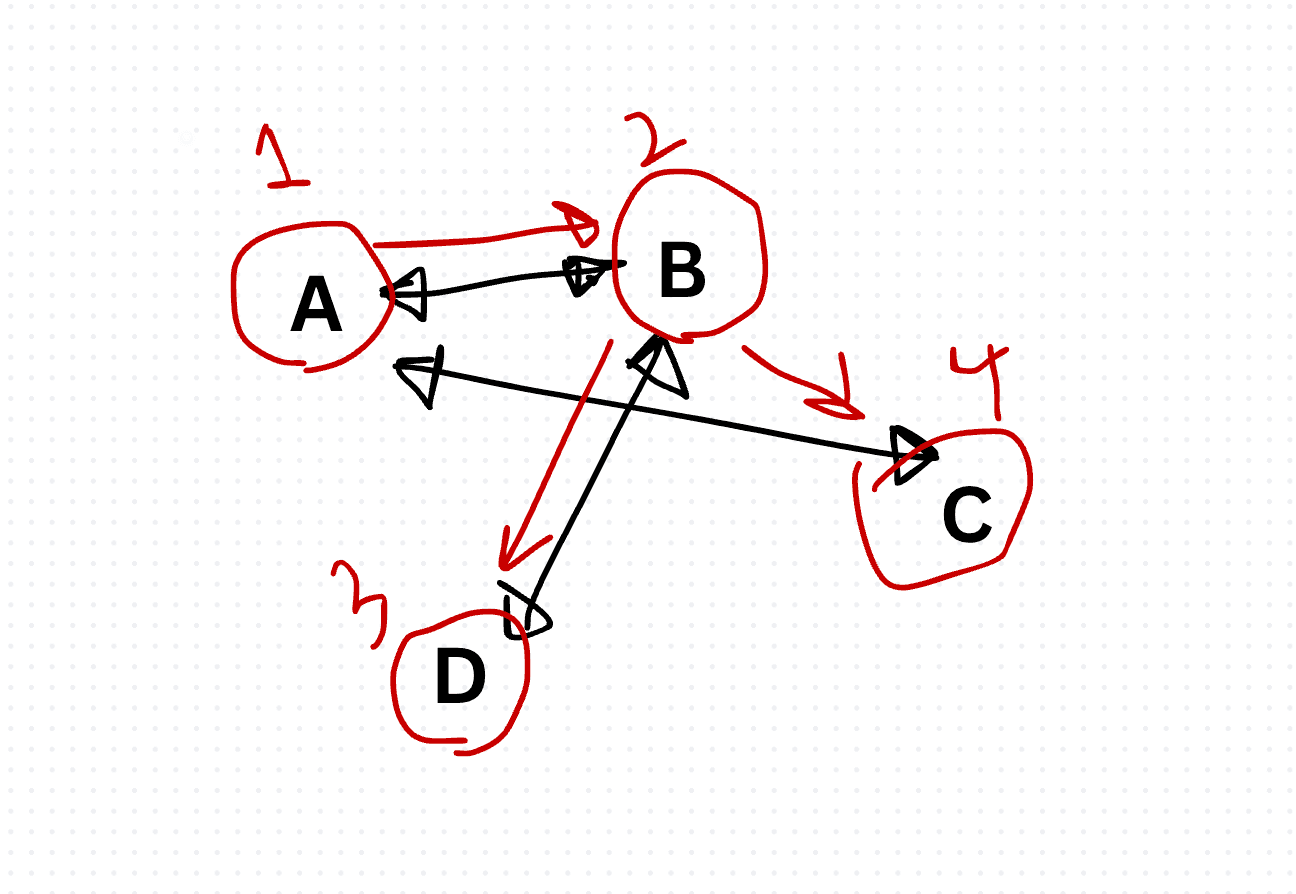
DFS goes deep before going wide. It picks a direction and follows it as far as possible. When it hits a dead end, it backtracks and tries the next path.
Think of exploring a maze. You follow one corridor to the end before turning back to try another.
What It Does
DFS traverses a graph by exploring each branch fully before moving to the next. It uses a stack (or recursion, which is an implicit stack).
The Code
class Graph {
  constructor() {
    this.adjacencyList = {};
  }

  addVertex(vertex) {
    if (!this.adjacencyList[vertex]) {
      this.adjacencyList[vertex] = [];
    }
  }

  addEdge(v1, v2) {
    this.adjacencyList[v1].push(v2);
    this.adjacencyList[v2].push(v1);
  }

  dfs(start) {
    const visited = new Set();
    const result = [];

    const traverse = (vertex) => {
      visited.add(vertex);
      result.push(vertex);

      for (const neighbor of this.adjacencyList[vertex]) {
        if (!visited.has(neighbor)) {
          traverse(neighbor);
        }
      }
    };

    traverse(start);
    return result;
  }
}

const g = new Graph();
['A', 'B', 'C', 'D', 'E', 'F'].forEach(v => g.addVertex(v));
g.addEdge('A', 'B');
g.addEdge('A', 'C');
g.addEdge('B', 'D');
g.addEdge('C', 'E');
g.addEdge('D', 'E');
g.addEdge('D', 'F');

console.log(g.dfs('A'));
// ['A', 'B', 'D', 'E', 'C', 'F']
How It Works
Starting from A:
- Visit A → go to B (first neighbor).
- Visit B → go to D.
- Visit D → go to E.
- Visit E → C is unvisited, go to C.
- C's neighbors are all visited. Backtrack.
- Back to D → visit F.
- Stack is empty. Done.
Complexity
- Time: O(V + E) — visit every vertex, check every edge.
- Space: O(V) — the recursion stack can go as deep as the number of vertices.
DFS vs BFS
| DFS | BFS | |
|---|---|---|
| Data structure | Stack | Queue |
| Memory | O(depth) | O(width) |
| Shortest path? | No | Yes (unweighted) |
| Best for | Deep graphs, topological sort, cycle detection | Shortest path, level traversal |
When to Use DFS
- Cycle detection — if you visit a node that's already on the current path, there's a cycle.
- Topological sorting — process dependencies in order.
- Solving puzzles — mazes, Sudoku, N-Queens.
- Connected components — find all nodes reachable from a start.
The Trade-off
DFS uses less memory than BFS on wide graphs. But it doesn't find shortest paths. And on very deep graphs (or infinite graphs), DFS can get stuck. BFS is safer when you care about distance.
Production-Ready Systems with LLMs and Agents
A live Maven cohort, 5 October to 2 November: eight 90-minute sessions where you build LLM and agent systems that survive real traffic, real cost and real failure. Tuesdays and Thursdays, 7:30 to 9:00pm London.
Cohort 2 starts 5 October. Eight live sessions, $1,500.
View the live cohortKeep reading
- The Algorithms Worth Knowing in Code Review: Cutting Big O Without Being Clever
- Tracking Down the Mystery: Finding the Unique Delivery ID
- Elusive Least Occurring Number in an Array
- Solving the Height of a Binary Tree Puzzle
- Harry Potter Discounts: A Code Challenge Algorithm
- Implementing a Task Heap Service in TypeScript