Palindrome Algorithm
A palindrome reads the same forwards and backwards. "racecar" is one. "A man, a plan, a canal, Panama!" is too — once you strip out spaces and punctuation.
10 Mar 2024
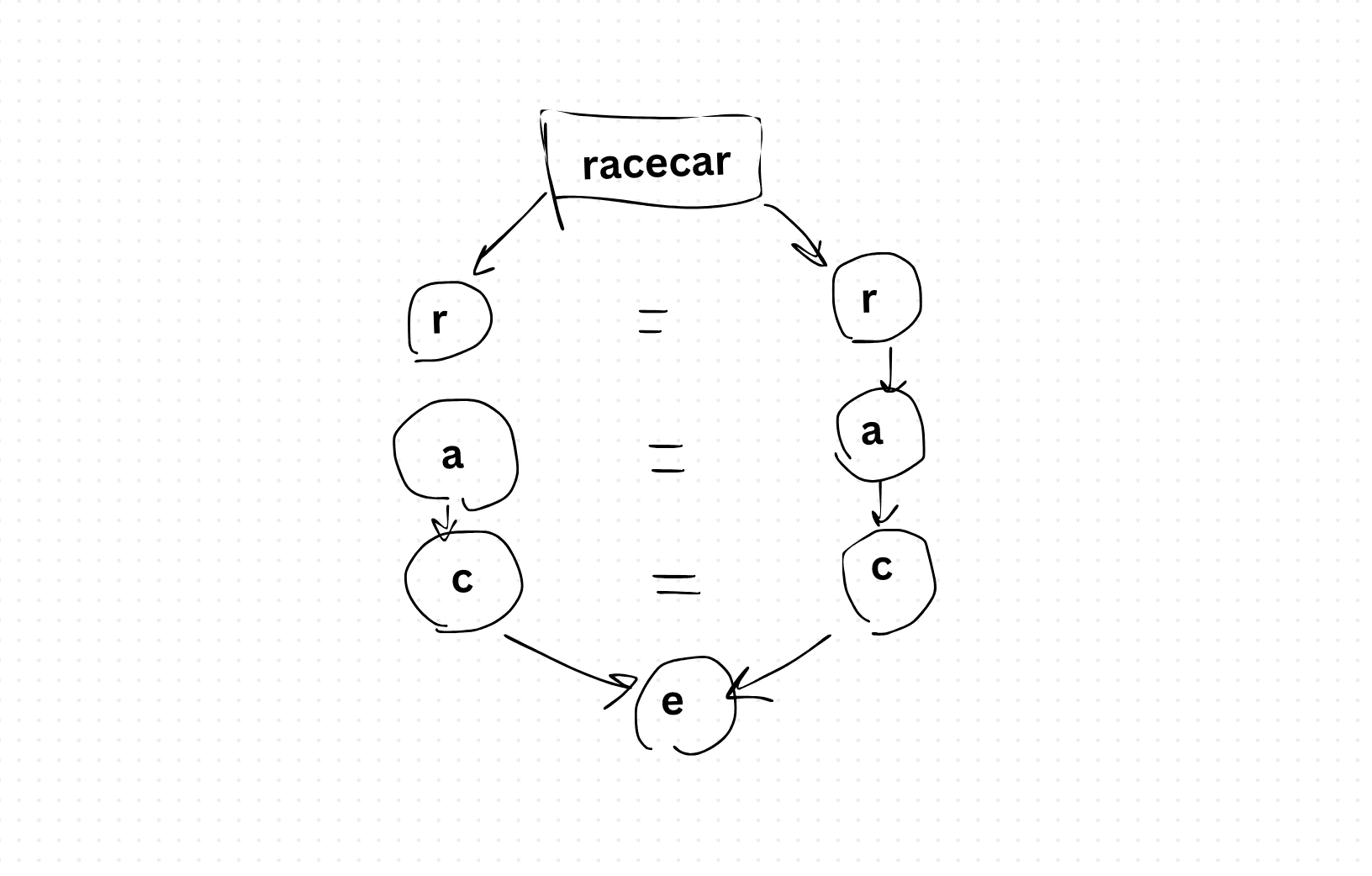
A palindrome reads the same forwards and backwards. "racecar" is one. "A man, a plan, a canal, Panama!" is too — once you strip out spaces and punctuation.
The problem
Given a string, determine if it's a palindrome. Ignore case and non-alphanumeric characters.
The clean approach
Strip everything that isn't a letter or number. Lowercase it. Compare from both ends using two pointers.
const isPalindrome = (input) => {
    const cleaned = String(input)
        .toLowerCase()
        .replace(/[^a-z0-9]/g, "");

    let left = 0;
    let right = cleaned.length - 1;

    while (left < right) {
        if (cleaned[left] !== cleaned[right]) return false;
        left++;
        right--;
    }

    return true;
};
The one-liner (less efficient)
const isPalindrome = (input) => {
    const cleaned = String(input).toLowerCase().replace(/[^a-z0-9]/g, "");
    return cleaned === cleaned.split("").reverse().join("");
};
Complexity
Two-pointer approach:
- Time: O(n) — single pass from both ends.
- Space: O(n) — for the cleaned string. Could be O(1) if you skip non-alphanumeric characters in place.
Reverse approach:
- Time: O(n) — but with higher constant factor (split, reverse, join each iterate the string).
- Space: O(n) — creates multiple intermediate arrays.
Trade-offs
The two-pointer approach is more efficient and exits early on mismatches. The reverse approach is more readable and works great for quick scripts. In an interview, show the two-pointer version — it demonstrates that you understand you don't need to check the whole string once you find a mismatch.
Production-Ready Systems with LLMs and Agents
A live Maven cohort, 5 October to 2 November: eight 90-minute sessions where you build LLM and agent systems that survive real traffic, real cost and real failure. Tuesdays and Thursdays, 7:30 to 9:00pm London.
Cohort 2 starts 5 October. Eight live sessions, $1,500.
View the live cohortKeep reading
- The Algorithms Worth Knowing in Code Review: Cutting Big O Without Being Clever
- Tracking Down the Mystery: Finding the Unique Delivery ID
- Elusive Least Occurring Number in an Array
- Solving the Height of a Binary Tree Puzzle
- Harry Potter Discounts: A Code Challenge Algorithm
- Implementing a Task Heap Service in TypeScript