How would you design Netflix?
Netflix streams video to 230+ million subscribers worldwide. Simultaneously. In varying network conditions. On thousands of different devices. And the vid...
31 Mar 2024
Netflix streams video to 230+ million subscribers worldwide. Simultaneously. In varying network conditions. On thousands of different devices. And the video quality adapts in real-time to your bandwidth.
The system design challenge isn't "how do you play a video." It's "how do you play a video for 230 million people at the same time without buffering."
Non-Technical Requirements
- Scalability — handle millions of concurrent streams. Peak traffic during new releases (think "Stranger Things" launch day) can be orders of magnitude above baseline.
- Reliability — buffering is the worst user experience. The system must be resilient to server failures, network issues, and traffic spikes.
- Content Variety — thousands of titles across genres, languages, and regions. Each with different licensing restrictions by country.
- Personalization — every user sees a different homepage. Recommendations drive engagement. Netflix estimates its recommendation engine saves them $1 billion per year in reduced churn.
- Device Compatibility — smart TVs, phones, tablets, gaming consoles, web browsers. Each with different screen sizes, codecs, and DRM requirements.
Technical Requirements
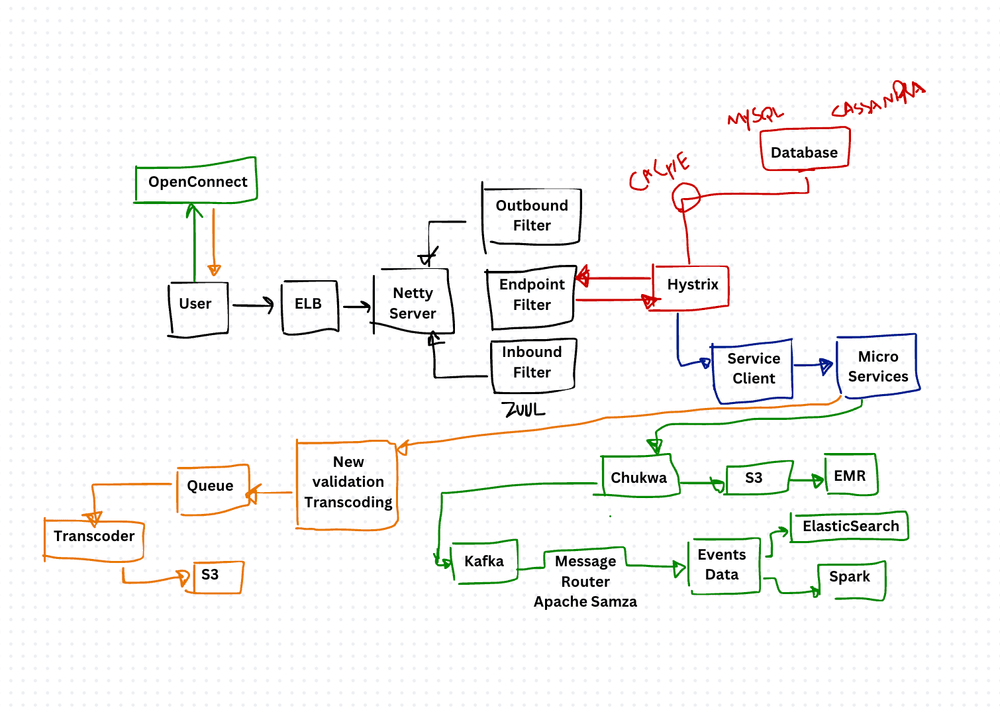
- CDN (Content Delivery Network) — video files are cached on edge servers close to users. This is the most critical piece. Netflix built its own CDN called Open Connect, deploying appliances inside ISP networks. The closer the content, the lower the latency and the less bandwidth crosses the internet backbone.
- Adaptive Bitrate Streaming — video is encoded at multiple quality levels (from 240p to 4K). The player switches between quality levels based on current bandwidth. Slow connection? Drop to 720p. Fast connection? Jump to 4K. The transition must be seamless.
- Recommendation Engine — analyzes viewing history, ratings, time of day, device, and even how long you browse before selecting something. Uses ML models (collaborative filtering, deep learning) to rank content. The row titles on your homepage ("Because you watched X") are themselves personalized.
- User Auth and Authorization — account management, profile switching, device limits, parental controls. Multiple profiles per account, each with independent viewing history and recommendations.
- Real-Time Analytics — monitor stream quality, error rates, and viewer engagement in real-time. If a specific ISP's users start buffering, Netflix can detect it within minutes and reroute traffic.
Low-Level Design
- Microservices Architecture — Netflix pioneered microservices at scale. Hundreds of independent services, each owning a specific domain. They can fail independently without taking down the whole platform.
- Content Ingestion Pipeline — studios upload a master file. Netflix transcodes it into hundreds of versions: different resolutions, bitrates, codecs (H.264, H.265, VP9, AV1), audio tracks, and subtitle formats. This happens before the content is available to users.
- Distributed Database — Cassandra for user data, viewing history, and bookmarks. DynamoDB for session data. EVCache (custom Memcached) for caching. Different stores for different access patterns.
- Edge Caching — Open Connect appliances pre-load popular content during off-peak hours. When a user hits play, the video streams from a server inside their ISP's network, not from a distant data center.
- ML Models — TensorFlow and internal frameworks for recommendation, thumbnail personalization (they test different artwork per user), and content quality prediction.
High-Level Design
- Client Applications — apps for every major platform. Each implements the adaptive bitrate player, DRM decryption, and UI rendering.
- CDN Layer — Open Connect handles 95%+ of traffic. Content is pushed to edge servers. Only metadata and API calls go to the central backend.
- API Layer — handles authentication, profile management, content catalog queries, and playback session management. Sits behind Zuul (API gateway) with rate limiting and routing.
- Recommendation Service — generates personalized recommendations, ranking, and search results. Updated periodically with batch processing and refined with real-time signals.
- Monitoring — Netflix built its own monitoring stack. Atlas for time-series metrics. Edda for change tracking. Chaos Monkey for resilience testing (they intentionally kill production servers to verify the system handles failures).
The Trade-Offs
Pre-encoding vs. on-demand transcoding. Netflix pre-encodes everything into hundreds of versions. This uses massive storage but eliminates transcoding latency at playback time. YouTube, by contrast, does some on-demand transcoding. The trade-off is storage cost vs. playback speed.
Own CDN vs. third-party CDN. Netflix built Open Connect because no third-party CDN could handle their scale cost-effectively. But building and maintaining a global CDN is a massive infrastructure investment. For smaller video platforms, Cloudflare or Akamai is the right choice.
Personalization accuracy vs. content diversity. A perfectly optimized recommendation engine creates filter bubbles — users only see content similar to what they've already watched. Netflix intentionally injects diversity ("explore" rows) to counteract this. Better recommendations drive engagement, but too-narrow recommendations limit discovery.
Complexity vs. resilience. Hundreds of microservices means hundreds of potential failure points. Netflix invests heavily in resilience: circuit breakers (Hystrix), chaos engineering, fallback logic. This operational cost is enormous. But for a service where buffering costs subscribers, it's worth it.
Netflix's system design is a masterclass in scaling video delivery. The key lesson: move the content as close to the user as possible, and design every component to fail gracefully.
Production-Ready Systems with LLMs and Agents
A live Maven cohort, 5 October to 2 November: eight 90-minute sessions where you build LLM and agent systems that survive real traffic, real cost and real failure. Tuesdays and Thursdays, 7:30 to 9:00pm London.
Cohort 2 starts 5 October. Eight live sessions, $1,500.
View the live cohort